|
|
|
|
|
|
|
|
|
|
|
KES Chess A Team 1968-1971 |
||||||||




|
Contents
Page Contents
Page 2 Contents
|
Non-Chess Stuff
In 1970, the British Championships were held at the University of Warwick’s Rootes Hall, which far from being in Warwick is halfway thence to Kenilworth. After the event, Chess Magazine published a letter from Stanley Lorley decrying the conduct of a competitor in the Ladies Championship, effectively implying this was no “lady”.
By an amazing coincidence, Steve Lorber and Ralph Bailey had been playing at Warwick. Now, if you take the first half of Lorber and append to it the second half of Bailey, hey presto, you get “Lorley”. Steve Mann was also playing at Warwick, and had no part in concocting the letter in question, and he would of course deeply censure the latter’s fabrication by his fellow Edwardians. You may of course choose not to believe Steve and Ralph had anything to do with this cheap schoolboy prank. You may also choose to believe pigs can fly.
Charles Henry Baker had a way of dealing with such things.
There was an occasion in form 1(3) of 1964-65 when the class, with Steve Mann among its number, was addressed by form master Charles Henry Baker announcing that, after long and hard anguished deliberation, he was going to cane Peter Edwards. No indication of Peter’s misdemeanour was given, but it appeared to relate to something Peter had put in some written work, something which could perhaps be paraphrased by “CHB is obviously an idiot.” Peter was seemingly regarded as being basically a good lad, but “Sir” felt whatever it was could not be allowed to pass unpunished. The caning subsequently took place, though not in view or the rest of the class.
In those pre-Batsford days, there was a series of books on openings by Rolf Schwarz, and there was an occasion when Steve Lorber ordered a copy of Rolf Schwartz’s book on Bird’s Opening from B. H. Wood’s Chess Ltd. Wood had obviously spotted the address on the order and chosen to write a personal note to the customer. Obviously there was a mix up, because a copy of the book was despatched in the normal way, and another copy was despatched with a covering note from B. H. Wood, which said something semi-poetic, along the lines of “Did you not know that I once lived but just 100 yards from where you now live?” Steve L then sold the second copy to Steve Mann at half-price!
The standard single-volume book on openings was Modern Chess Openings by Walter Korn. Steve Mann decided to order a copy from Ward’s bookshop on Chapel Walk in Sheffield. Ralph Bailey got wind of this plan and asked me to order a second copy for him. When I’d paid for and collected the two copies, on getting them home I found a page in one copy had half of one page missing. The opening so affected was some variation of the French Defence, so, as I was never likely to play the variation covered by the missing page, I decided I’d keep the damaged copy and let Ralph have the intact one.
Steve Mann has long had an interest in Scottish Gaelic, not so much learning to speak it, but more how it evolved within the framework of Indo-European languages and its consequent relation to other languages. The interest was kindled by Gaelic Without Groans by John Mackechnie, and learning of this interest Steve Lorber kindly purchased and donated Teach Yourself Gaelic by Roderick Mackinnon (printed 1973) when he espied a copy. Steve M now has innumerable books on Gaelic, including numerous dictionaries the most prized one being a facsimile reprint of Edward Dwelly’s hefty Illustrated Gaelic-English Dictionary, the completion of which was funded by a pension provided by none other than the then Prince of Wales, known as “Bertie” to his mum and in due course becoming the eponym of KES!
There must have been times when the two Steves M went home together, both living in the Nether Edge area. Indeed, I (Steve Mann) can remember approaching the bridge over the Porter Brook at the foot of Frog Walk in the company of Steve Mall and his younger sister who attended the Girls High School, a back entrance to which was the other side of Newbould Lane from KES. The Mallaband siblings going home from school together would be exceptional as for KES the school day ended at 4 p.m. whereas at the High School it ended at 3.30 p.m. I remember Steve’s sister using the non-word “gooses” at that point approaching the bridge, which is probably the only reason I remember the occasion.
If there was ice on the steep Frog Walk then I used to make a detour through the Cemetery, but that’s not the alternative route alluded to.
One day, the exact circumstances of which I forget, the Steves M were going home together in the company of a younger member of the chess club. Having got to the roundabout at the top of Rundle Road down which we would normally have continued, our younger companion said he’d show us another route home. For him this was a short cut, but for us it was a diversion, both literally and metaphorically. .Accordingly, he led us into the expansive grounds of the Kenwood Hotel, the entrance of which was in the angle between Rundle Road and Kenwood Road. He took us to the southern perimeter of the grounds where we climbed over a wall into someone’s back garden, our guide assuring us the owner would not mind! Emerging from the front garden of the property must have brought us to the top of Montgomery Avenue where, presumably, our guide lived. The Steves M could then get to their respective homes easily enough.
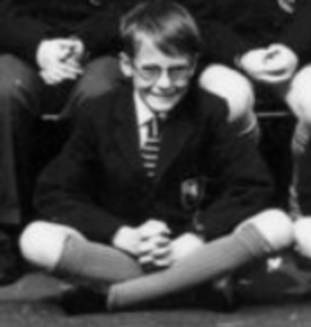
It was once reported that one of the younger chess club members had gone to a chess congress and used as overnight accommodation a rubbish skip. This was not an open-top skip with a tarpaulin to keep the rain out, but a relatively upmarket skip in that it had a metal roof. This person may have been the guide in the above Alternative Route Home, and I have a strong feeling the chap in the skip was a younger chess club member called Barry Wardle, who was born on 25/01/1957, started at KES in 1968 and died in December 2005 aged 48. He looks maybe to have been a “character” rather than the serious type in a 1968 1(2) form photograph:
For a photo of Barry playing in Sheffield’s annual “Association v Works” match (now long discontinued) see here. He later played for the Earl of Arundel chess club in Sheffield, and played, for instance, in the Intermediate section of the Sheffield Easter Congress of 1999. I (Steve Mann), as one of the organisers of that congress, can state that the website 365Chess.com has things sadly mangled at https://www.365chess.com/tournaments/Sheffield_op_1999/8027. Nevertheless, the two games attributed to Barry, allegedly in the Open section though he was in the Intermediate section, are probably correct, as his opponents, Callis and Cunningham, were also actually in the Intermediate section.
During the lunchtime sessions mentioned on the Chess Club page, the second team’s Michael Marks (pictured on the Sunday Times page) delighted in making moves which at first sight looked bad but were okay. These were not profound moves but just any simple way of putting a piece en prise when it could not safely be taken, just for the humorous nature of the move, saying in effect, “Ya-boo, you can’t take that!”.
My sister learnt to play the piano, but I (Steve Mann) was more “into” wind instruments. My early preference was for trumpet music, in particular Percell’s Trumpet Voluntary by Jeremiah Clarke (!) but later I preferred the flute. Thus, I learnt to play the flute. Some among the chess team were members of the school orchestra and it was suggested I too joined the school orchestra. However, I just enjoyed playing the thing, not taking it over seriously, so thought the orchestra was not for me. Nevertheless, I attended KES school concerts and one year was pleased to hear Ian Manning, who was not a chess-player, playing a solo flute piece by Georg Philipp Telemann which I myself had played, but nowhere near as well as Manning! The memory holds music remarkably well, and I still recall the tune. He was playing it as he’d won the Junior Composition prize with it, pretending he’d written it himself. So, rather as with the Trumpet Voluntary, it was Telemann’s whatever-it-was by Ian Manning! I mentioned this to the musical chess-players because it was so funny. They, however, urged me to tell “Sir” (Norman J Barnes, M.A., Oxon., B.Mus., F.R.C.O., later to become MBE). He requested seeing my copy of the score, so next day I took in my book of flute music for him to see. Next, I was summoned by the headmaster to whom I had to recount the tale. The “Sirs” didn’t seem to take the same good-humoured approach as I, and I suspect Manning may subsequently have got some stick, literal or metaphorical!
One of the Sheffield Junior Chess League’s activities was to play matches (I remember two) against Manchester Juniors. On one such occasion in Sheffield, Paul Machin, a cousin of Abbeydale's Steve Everson, gave his name to his opponent as Zoltan P Nezhmetdinov. There was a Soviet player of Tatar extraction called Rashid Gibyatovich Nezhmetdinov, so the surname might have been known to the Mancunian opponent. Paul’s identity was further confused when some time/years later, Paul went to a job interview in Tunbridge Wells, and the interviewer was none other than former Sheffielder Jim Scholes. Jim knew the interviewee had been a Sheffield junior chess-player, but was clearly hazy as to which one was which and was confusing Paul with Steve Mann who Jim had seen on occasion at the old Hillsborough Chess Club.
Some years ago, I met up in Sheffield with Norman Wilson, ex Abbeydale chess-player now resident in London since before 1979, the year of his first marriage. We walked into the centre of Sheffield from the Archer Road area of Millhouses, visiting his old school, Abbeydale Boys’ Grammar on Hastings Road, and thence to 42 Sheldon Road where he grew up. On arrival at Hastings Road, we marvelled at what his old school looked like now, literally a pile of rubble!! Is KES now similarly a pile of rubble? It shouldn’t be, as it’s been a “listed” building since 28/06/1973, though Sheffield Council has been known to demolish a listed building before today!
In the context of involvement in the organisation of chess congresses in Sheffield, I (Steve Mann) have a number of times entered the hallowed portals of the former second-class prisoner of war camp, as deputy head Andrew Jackson described it as an aide memoire for remembering the school’s postcode, S10 2PW.
Inside, things were much unchanged. Various darker recesses which had in the past been the province solely of the school caretaker and cleaning staff had been opened up as things like a sixth form common room, one such area being available to parents and spouses of competitors in a congress.
The “backs” (toilets) to the rear had gone and toilets were now indoors, boys and girls respectively being at opposite ends of the ground floor (taking over what had been PL1), but the canteen was still there in the centre of the ground floor below the assembly hall, and served as an analysis room at congresses.
Chess master Gorden Young Adam (“Fanny”) taught Russian to some of us as a subsidiary subject during the A-level years 7 and 8. He once gave us a list of sentences illustrating various key grammatical structures and idioms, one of which was Я предлагаю ехать на лифте, meaning “I suggest to take the lift”, or “I suggest taking the lift” as the English manner of expression puts it. Peter Edwards once narrated the following:
Oddly enough, when I took a temporary job in the cost office of Osborn Mushet Tools before going to university, a certain David Banks from my year at KES was already there, and he delighted in quoting the same sentence from that list. It is clearly found catchy by all who hear it. The point of all this? . . . .
Now, filling the rectangular space up the centre of each of the spiral staircases at the two ends of the building, there are indeed lifts, making it now perfectly appropriate to say, “Я предлагаю ехать на лифте!”
The assembly hall was still there on the first floor opposite the grand main entrance. All looked very much as it was before, but now there is a newly built passage on the outside of lefthand side. This leads to a massive extension between the old back wall of the school and the wall along the side of Glossop Road. The first area reached was an IT suite, or something similarly named, extending to the left as well as to the right behind the old building. It was in this IT area that Sheffield Congresses held the Minor section which I controlled, it being the easiest to run. Going through the IT area you got to areas out of bounds to the congress.
The gymnasium was still there, though the wall bars had I recall been removed in the interests of health and safety, a consideration which did not arise in yesteryear!
Going outside from the east ground-floor side entrance, you might expect, looking across slightly to the left, a clear view to the swimming baths, but no! To the left of the path leading down to the baths was (and still is) a long building housing classrooms, built in 1996 by DBS architects. One of these rooms was used at a congress. Of course, if you go far enough you reach the baths which used to serve the school for part of the time and the public at other times. That shared use seems to persist.
So, the old KES has about doubled in size, and of course that doubled area is now serving only the upper school and so for the upper school it has more than doubled! The result in a way has perhaps (though I’m not qualified to comment) enabled the upper school to continue as some form of centre of excellence. On the other hand, the site separation of lower and upper schools has been held to have harmed chess at the school due to difficulty of interaction between the two groups of pupils. Indeed, there came a point when chess no longer got a mention in successive school magazines.
A plan of the present layout can be seen here.
Two prominent members of the Earlier Generations of KES chess-players shared in common the fact that their respective versions of vehicular transport that they liked to dignify with the term “car” were candidate deathtraps which I’d expect not to pass an MOT test.
In the case of Roger Hoole, if, when driving uphill to a transverse major road ahead, he needed there to stop, then he had to gingerly drive onto the major road turning left, so that when the engine stopped, the breaks were equal to the task of stopping the car roll backwards. Staying on a backward slope would not allow the feeble breaks to hold.
Maintaining this tradition, Paul Kington entertained his passengers differently. I remember on the return journey from a match, he found it desirable to stop the car and courteously ask the person in the front passenger seat to get out, walk back along the road and retrieve the front passenger door which had dropped off. It was then an easy matter to re-attach the door, once the front passenger was reseated, and continue home.
Not to be outdone by the earlier generations, Steve Mallaband’s trick was far more discreet. The car involved was, I believe, a cast off of his father’s. There were no obvious defects in the car unless the nearside rear passenger partially lifted the mat on the floor. Doing this enabled said passenger to peer through a hole in the floor and watch the road surface whizzing past underneath the car. Clearly the hole was not bad enough to allow someone to fall through the floor, but it did not instil confidence, and I expect would not pass its MOT test.
Steve obviously enjoyed having four wheels at his disposal and took it into his head to undertake a trip to Spurn, and he asked me if I’d like to accompany him, but I declined the invitation. He may have asked others first and they’d declined. I’ll admit that, afterwards, I rather regretted declining that invitation. I don’t know if Steve actually went to Spurn with someone else or on his own or not at all. I hope he went.
If you were either Jewish by religion OR had practising Jewish parents – the distinction is of major importance – then, in addition to the Christianity-based holidays such as Christmas and Easter, you also got time off school for certain Jewish festivals. Mark Baker and Simon Flowers started at KES on 08/09/1964 1964 in form 1(3), but if you look at the form photograph on the A Team page, the two are conspicuous by their absence. A possible reason is that the taking of the photograph happened to coincide with a Jewish festival!
Mark was born in Sheffield on 23/01/1953. Roughly around his 17th birthday, give or take up to three months, Mark committed suicide. I remember Ralph mentioning they didn’t know why he’d committed suicide. It was the year we were due to sit the A-levels, but they presumably didn’t think that was the problem.
Well, going by what he’d said about Jewish practices which he viewed as highly hypocritical and not consistent with his own mind set, it was “clear” to me that he was having severe difficulties being, in effect, force-fed a religion he did not believe in. This he said on the bus taking us to games afternoon, top deck, lefthand side, towards the back. Some things you remember.
Personally, I can relate to that. My father was a C of E lay reader, my mother conducted meeting of Young Wives and Mothers’ Union. The whole extended family was steeped to the eyeballs in Christianity. So, I was sent to the Girls’ Crusaders on Sundays with my older sister. (They took boys in the junior of the two sections.) Then when I was too old for that I had the choice between Boys’ Crusaders or church. It wasn’t multiple choice with a “none of these” option. I quite believe my parents, like Mark’s, probably never thought I had contrary views, but, unlike Mark, I was able to live with it, going to evening service every Sunday at St Barnabus, Highfield, sometimes with my father getting a turn at preaching to the congregation from the pulpit.
So, a belated and sympathetic R. I. P to you, Mark.
On a more cheery note, it appears Simon Flowers went on to get married in 1985, in Hounslow, to Marian B Sharman, if that’s our Simon B Flowers, but there seems to be only one in the system. Peter’s Spectacles
While at King Ted’s, I (Steve Mann) found I was becoming shortsighted, needing to sit fairly near the front of the class to be able to read the blackboard. On one occasion, Peter Edwards had taken off his spectacles, and it occurred to be to see what they did for me. So, I put them on, and they were perfect, not just making my eyesight better with than without, but they were perfect in correcting my sight! Once agt university in Exeter I invested in my own spactacles enabling me to see everything, even from the back row of the auditorium.
\/ - Articles continued on Page 2 - \/
|